

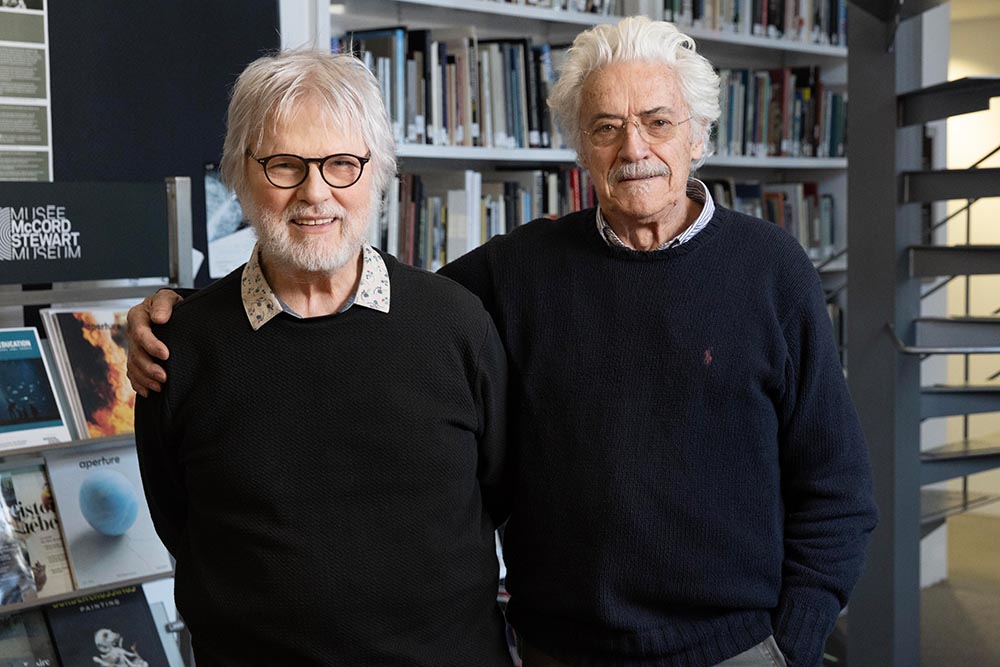
Yvon Laroche and Raymond Bellemare
Tomi Grgicevic © McCord Stewart Museum, 2025
Interview conducted on December 8, 2025.
[Raymond Bellemare and Yvon Laroche speak directly to the camera, sitting at a table in a light-filled archives centre.]
Raymond Bellemare: My mother once said that I was born with a pencil in my hand. In high school, I was the best at drawing. I used to make drawings for other students: 25 cents for colour, 10 cents for black and white. I started to make a name for myself, so to speak!
Yvon Laroche: When I was very young, I loved colouring books, which may seem quite different from graphic design. I was interested in the images, photos and posters that I saw.
[In a folder with plastic sleeves, Yvon Laroche points at black and white portraits of the designers who worked on the Organizing Committee for the Olympic Games (COJO), notably Pierre-Yves Pelletier and himself.]
Yvon Laroche: I shared a design studio in Old Montreal with Pierre-Yves Pelletier, who was already an internationally known designer. Pierre-Yves was named art director at COJO.
[Standing side by side, Raymond Bellemare and Yvon Laroche leaf through the folder with the plastic sleeves as they talk.]
Raymond Bellemare: Pierre-Yves Pelletier got me interested in becoming a member of the Olympic graphic design team. I worked at COJO for three years.
[In a black and white photograph, a young Raymond Bellemare smiles in front of a series of graphic designs posted on a wall.]
Yvon Laroche: I never actually worked at COJO. I was a contract worker.
[Yvon Laroche turns the pages in the folder. Two black and white portraits of him from the 1970s are laid out next to a contemporary colour portrait of him.]
Raymond Bellemare: It wasn’t a very well known profession in the 1950s and 1960s. We had to explain what we did. We did the graphic design and layout for publications. It was an abstract concept for people.
Raymond Bellemare: Expo 67 took place before. A decade or so later, there was the Olympics.
[Two posters of Expo 67 appear—one red, the other blue.]
Raymond Bellemare: This led to the creation of businesses specializing in design, like graphic design or industrial design, for example. It was like people suddenly became aware of graphic design.
Yvon Laroche: The Olympic Games marked the beginning of the growth in graphic design. The 1970s were truly a golden era.
[A poster for the Olympic Games with a grey background and a rainbow band running up the middle depicts technical drawings of the Olympic Stadium from several angles. A poster with a white background features the black silhouette of the Games mascot, Amik the beaver, with a diagonal rainbow band. Notebooks in the colours of the Games, sitting on a table, display the variety of designs created for the event.]
Raymond Bellemare: A project like this was obviously great for your portfolio. Everything was published internationally, so it was gratifying to know that people around the world were seeing and appreciating our work. Back then, we had to use tools—squares, compasses, ruling pens, panels—to physically lay out our design elements. It was nothing like what we can do now, with computers. At that time, graphic designers all had to be crafty, out of sheer necessity.
Yvon Laroche: This was long before computers, Illustrator, Photoshop, or InDesign. We used to work with typesetting studios. We would purchase custom typography and they would print the reproduction quality proofs. They worked three shifts, day and night, 24 hours a day. It was a big undertaking.
Raymond Bellemare: It was an extraordinary project for designers. I think it was the last, or nearly last, major event in Montreal.
[Standing, the two leaf through a folder.]
Yvon Laroche: It was an absolutely incredible opportunity to practise our profession of graphic designer. We were truly privileged to be able to work on it.
Raymond Bellemare: It involved hours and hours of work. Well, at least we weren't getting into any trouble while we were working!
[Sitting side by side, Yvon Laroche and Raymond Bellemare laugh heartily.]
[The McCord Stewart Museum logo appears in white on a black background. Copyright: McCord Stewart Museum, 2026, appears in the lower right corner of the screen.]